



Retaining top talent within an organization is strategically important, as it supports competitiveness, innovation, and financial performance. Talented individuals stay in organizations where they feel well, can grow, and find their work meaningful. An individual’s commitment to an organization is a deeply psychological phenomenon, and effective people management plays a key role in maintaining and strengthening it. By reading our blog post’s six core insights, you’ll understand what kind of performance management and culture help retain top talent in your organization.
Performance Management and Commitment Begin with Meaning
Most people have a strong need to find their work meaningful. This doesn’t necessarily mean grand missions, but rather an understanding that their efforts make a difference—whether to customers, the team, or a shared goal. Generation Z in particular seeks meaningful work aligned with their values and expects leadership to support their autonomy, development, and well-being. The meaningfulness of work has become a key factor in talent retention, and it cannot be cultivated without genuine psychological understanding of people.
Managers play a central role in discussing and setting goals. Goals provide a view into the future and open up new opportunities. A manager can influence how goals are internalized by articulating the broader impact of the work and helping the employee see the value of their contribution. Successful performance management for top talent allows room for job crafting in a way that supports the individual’s values and strengths. Psychologically, this connects to intrinsic motivation. A high-performing employee understands why they do their work. In such cases, motivation doesn’t stem from external rewards—it grows from within.
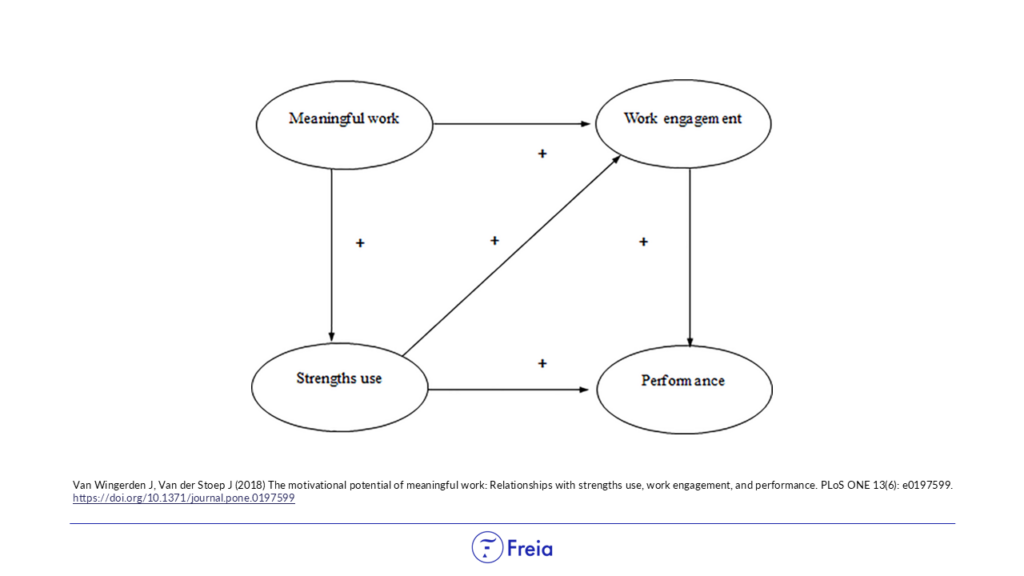
Connections between performance management, meaningful work, strengths and work engagement
Autonomy – Freedom with Direction
One of the most important drivers of motivation is autonomy—the experience of having influence over one’s own work. Top talent values freedom, but from a performance management perspective, they also need clear goals and boundaries. It’s the manager’s role to build a framework within which freedom can flourish. This strengthens psychological ownership. When an employee feels that their work truly belongs to them, they are more likely to commit to it.
A Sense of Safety Enables High Performance
High performance emerges in environments that are psychologically safe. In practice, this means being able to be oneself, ask questions, make mistakes, and learn. It also forms the foundation for being able to receive feedback that supports personal growth. To foster psychological safety, managers should regularly ask themselves and their teams: Is this a team where even top talent feels safe to fail? How do we respond to failure, and how do I act in those situations?
It’s worth having open conversations with the team about feedback culture and making changes if needed to create a more emotionally safe climate. Feeling safe enables courage—to experiment and to challenge. In such an environment, individuals know that failure does not threaten their value or the respect they receive.
Individual Leadership – A Psychological Cornerstone of Performance Management
Each of us has a need to be seen as our authentic selves. When an employee feels that their manager truly knows them—understands their strengths, development goals, and personal situation—it fosters deeper commitment. This doesn’t require miracles, just genuine interest and regular, inspiring conversations.
Individual attention also means recognizing personal motivators. You can explore this topic further in our blog post on personalized leadership.
The Feeling of Competence – Work That Challenges Just Right
Intrinsic motivation grows when top performers feel they are developing, learning, and excelling at what they do. That’s why people value clear goals, feedback, and the right level of challenge. When work challenges an individual in a way that suits them, it strengthens their sense of competence—one of the core psychological needs alongside safety and autonomy.
Organizational Culture and Leadership Processes
Organizational culture provides the broader framework for the actions of leadership and managers. A culture that fosters success requires that the principles of performance management are shared and understood by all leaders. It’s important to develop clear operating models within the organization—such as common practices for performance management, documented processes for competence development, and procedures for managing work ability—that support both managers and employees in their daily work and career growth.
Summary
Retaining top talent is not about a single trick. At its core, it’s about understanding people as individuals—with their strengths and needs. That’s why performance management is never just a conversation about goals and metrics. At its best, it’s a way of leading people that acknowledges their core psychological needs: autonomy, meaning, competence, and safety. When these elements are present in everyday work life, they create a workplace where employees thrive. Good employees grow into exceptional professionals. The atmosphere becomes inspiring, and top talent chooses to stay.
Four Tips for Managers
- Have regular conversations with your team members. Don’t shy away from discussing more challenging topics, such as the meaningfulness of work and experiences of failure.
- Aim to set individually tailored goals with each employee.
- Provide open, constructive, and appreciative feedback on work performance.
- Encourage top performers’ creativity and freedom to think independently
Related Blog Posts
Personalized Leadership – Why, How, and What Benefits?
Leadership in Uncertain Times – From Strategy to Shared Success
Experts
Päivi Frantsi, PhD Economics and Business Administration, Licentiate of Psychology, Myth Shatterer
Päivi is an experienced and enthusiastic coach for individuals and work communities. She approaches the challenges of human life with curiosity and uses her professional expertise to support both communities and individuals in achieving success and reaching their goals. Päivi has coached a large number of managers to discover a new dimension and level of impact in their work.
Nico Saukkonen, Project Manager
Nico Nico works in Freia’s team designing and leading processes that promote work ability and well-being. He believes that systematic approaches, smart resource allocation, and building sustainable operating models must be at the core when investing in employee well-being and leadership development.
Antti Äikäs – CEO, PhD Candidate Sport and Health Sciences, Effectiveness Expert
Antti is an experienced expert in predictive analytics and strategic people development. He is specialized in identifying early‑stage signals in workforce metrics that influence organizational performance. Antti designs impactful leadership and people development initiatives, conducts agile organizational audits and advances work ability management practices.
Freia in brief
Freia is a sparring partner for people leadership and work ability, delivering impactful solutions for organizations in both the private and public sectors. Our mission is to create shared success.
References
- Coyle-Shapiro, J.A.-M., & Kessler, I. (2000). “Consequences of the Psychological Contract for the Employment Relationship: A Large Scale Study.” Journal of Management Studies, 37(7), 903–920. https://doi.org/10.1111/1467-6486.00210
- Edmondson, A. (1999). Psychological Safety and Learning Behavior in Work Teams. Administrative Science Quarterly, 44(2), 350-383. https://doi.org/10.2307/2666999
- Hotti, S. (2023). Goal Setting and Performance Management in Expert Work: The Experts’ Perspective (in Finnish). https://urn.fi/URN:NBN:fi-fe2023052447797
- Huovinen, A. (2024). Performance in Expert Organizations from the Perspective of Competence Management and Development. Master’s Thesis (in Finnish). Lut University. https://urn.fi/URN:NBN:fi-fe2024052436356
- Konstantara, M. K., & Galanakis, M. (2022). Organizational & Industrial Psychology in the 21st Century—Goal-Setting Theory and Performance Management: A Systematic Literature Review. Psychology, 13, 790-797.
https://doi.org/10.4236/psych.2022.135052 - Raymond, N., Hollenbeck, J. & Wright P. (2025). Human resource management: Gaining a Competitive Advantage. Evergreen release. McGraw-Hill Education.
- Ruohomaa, E. (2021). Performance Management Is Evolving (in Finnish). https://urn.fi/URN:NBN:fi:amk-2021060113320
- Ruotsalainen, M. & Kinnunen, U. (2013). Psychological Contract and Well-being Among Permanent and Fixed-term University Employees (in Finnish). Työelämän tutkimus, 11(1). https://journal.fi/tyoelamantutkimus/article/view/87224
- Smither, J., London, M. & Reilly, R. (2005). Does performance improve following multisource feedback. A theoretical model, meta-analysis, and review of empirical findings. Personnel Psychology. https://doi.org/10.1111/j.1744-6570.2005.514_1.x
- Van Wingerden, J. & Van der Stoep, J. (2018) The motivational potential of meaningful work: Relationships with strengths use, work engagement, and performance. PLoS ONE 13(6): e0197599. https://doi.org/10.1371/journal.pone.0197599