


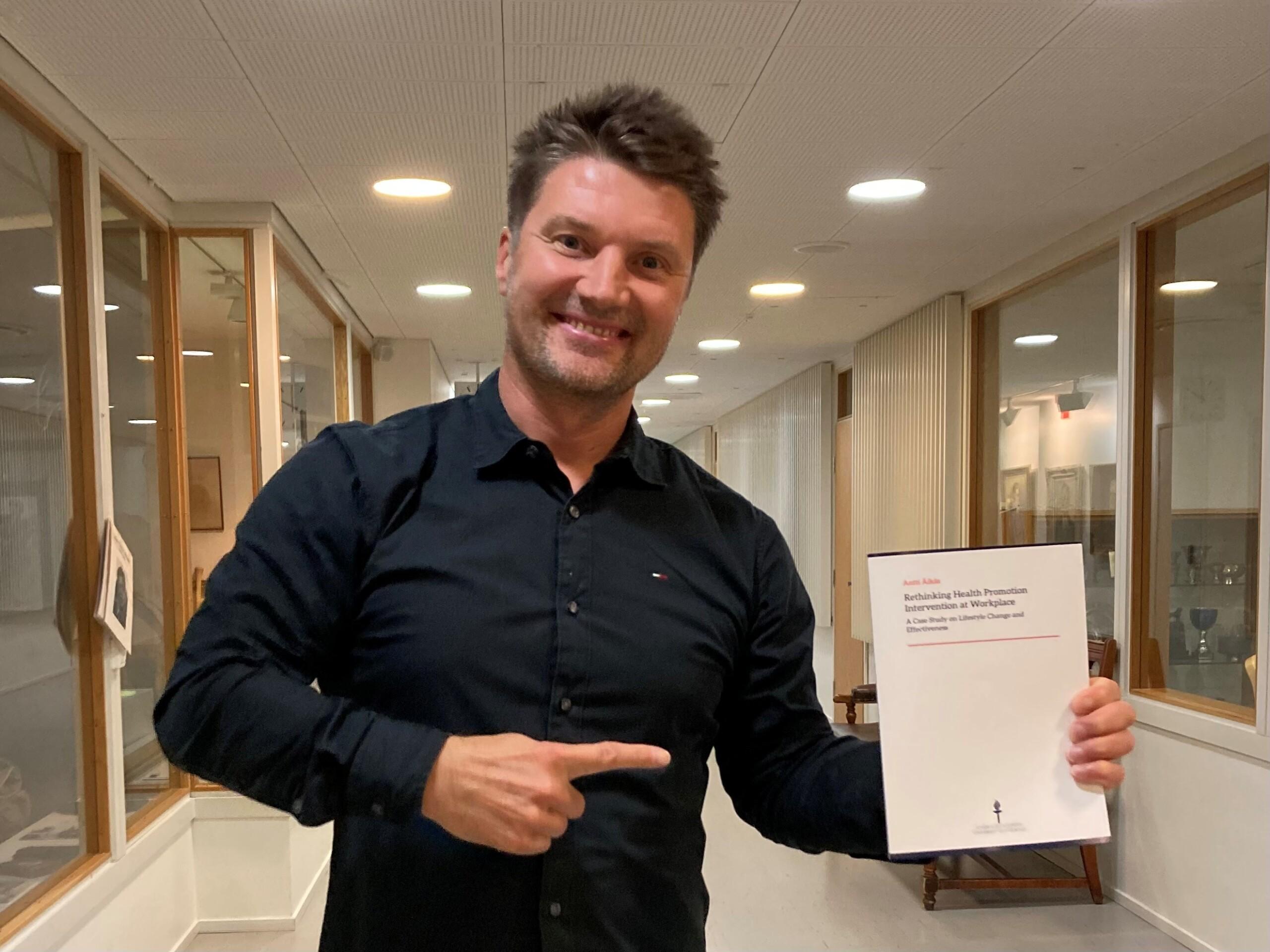
Antti Äikäs’s nine-year doctoral research challenges the short-term way in which workplaces often develop and evaluate workplace wellbeing. The results show that impact is built through long-term management, employee participation, services targeted to actual needs, and systematic follow-up.
The effects of workplace wellbeing are often evaluated too early
Workplace wellbeing programmes are often launched as fixed-term projects and evaluated during their first year. The assessment may then focus on participation figures, feedback, or short-term changes. Research in the field suggests that this timeframe is too short for evaluating the programme’s true effects.
Äikäs’s doctoral research was based on nine years of follow-up of a comprehensive workplace health promotion programme in a Finnish forest-sector organisation. The research simultaneously examined health-related fitness, health risks, work ability, sickness absence, and the programme’s financial effects. Employee health and wellbeing were therefore not treated as an isolated project, but as part of the organisation’s strategic development and performance.
The effects emerge over years
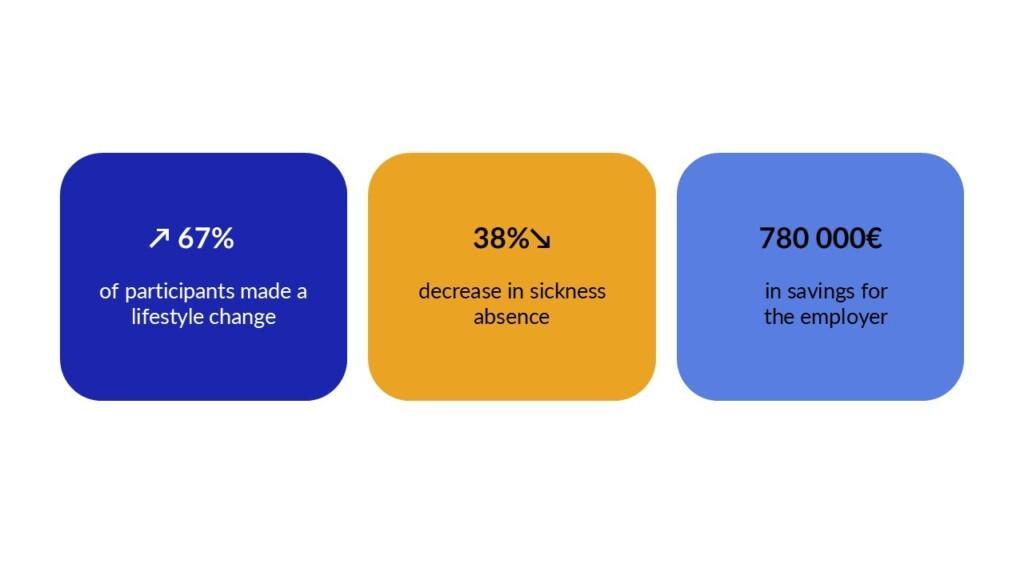
The key finding of the doctoral research was clear. The effects of workplace wellbeing and health promotion develop slowly and can only be reliably observed through long-term follow-up. During the programme, 67 per cent of participants made a lifestyle change, sickness absence decreased by 38 per cent, and the programme reached 58 per cent of the entire workforce. The results demonstrate both broad reach and the potential for health promotion support to become visible over time in individual wellbeing and organisational performance indicators.
A long-term approach does not mean mechanically repeating the same activity year after year. An effective programme evolves with the needs of the organisation and its employees. It requires management commitment, genuine employee participation, appropriately targeted services, and follow-up data that can be used to develop the programme.
“Workplace wellbeing should be managed as an investment rather than as a short-term project. Its true effects cannot be assessed on the basis of a single year.”
Employee wellbeing and productivity are interconnected
Discussion about workplace wellbeing can easily split into two different perspectives. One focuses on employee health, coping, and work ability, while the other focuses on productivity, costs, and performance. The findings support the view that these perspectives are part of the same whole. Over the long term, changes in employee wellbeing can be reflected in sickness absence, the costs of lost work, and the organisation’s ability to achieve its goals.
Workplace wellbeing initiatives should therefore be approached in the same way as investment decisions. The first steps are to define the objective and establish the baseline. Measures are then selected according to identified needs, implementation quality is ensured, and change is monitored for a sufficiently long period. Evaluation should examine not only what was done, but also who was reached, what changed, and how the effects were reflected in the organisation’s key performance indicators.
From measurement to prediction
In most organisations, workforce data primarily describes the past. Sickness absence figures, occupational health reports, and employee surveys tell management what has already happened. This information is valuable, but it often arrives too late for proactive management. By the time a work ability problem or cost impact appears in a metric, an unfavourable trend may already have continued for a long time.
Traditional approach: Measure afterwards what happened. Initiatives are evaluated separately and over a short period
New approach: Combine data, identify trends, and act before impacts on work ability and costs materialise.
The next step is to move from descriptive measurement to predictive management. The aim is not to promise certainty about people, but to help management identify probable trends and target support at the right time. When workforce indicators are examined responsibly and over the long term, organisations are better able to safeguard employee wellbeing and work ability while proactively managing sickness absence and the costs of lost work.
What can organisations do now?
- Extend the evaluation timeframe. Set interim targets, but assess health, work ability, and financial effects as a multi-year whole.
- Integrate workplace wellbeing into strategy. Make responsibilities, resources, and follow-up part of the normal management system rather than a separate campaign.
- Engage employees. Design services around actual needs and reduce barriers to participation for different employee groups.
- Combine indicators. Examine participation, health changes, work ability, sickness absence, and costs as one integrated whole.
- Use data proactively. Identify weak signals and initiate support before risks turn into prolonged absences or rising costs.
The doctoral research on television
Antti Äikäs will discuss the research findings on Yle’s morning television programme on Monday, 21 September 2026, and on MTV’s Huomenta Suomi on Thursday, 24 September 2026. Exact broadcast times and programme links will be added to this page as soon as they have been confirmed.
Public examination
Antti Äikäs’s doctoral dissertation in physical education pedagogy will be publicly examined on Saturday, 19 September 2026 at 12:00 in the C1 Main Building Hall at the University of Jyväskylä. The language of the public examination is English. The opponent is Reader David Maidment from Loughborough University, and the custos is Associate Professor Kasper Salin from the University of Jyväskylä.
Live stream: r.jyu.fi/dissertation-aikas190926
Dissertation: Rethinking health promotion intervention at workplace
Would you like to discuss your organisation’s situation?
Would you like to discuss how the impact of workplace wellbeing, work ability risks, and the costs of lost work can be managed with a long-term approach in your organisation?
Book a discussion with Antti: slotti.fi/booking/freiaoy
Learn more about our work ability management
Antti Äikäs, CEO, Doctoral Researcher
Antti is an experienced expert in predictive analytics and strategic workforce development. His expertise lies in identifying weak signals within workforce data, designing impactful leadership and people development initiatives, conducting agile organizational assessments, and advancing work ability management.
About Freia
Freia is a trusted partner in leadership development, workforce capability, and occupational well-being. We deliver impactful solutions for private and public sector organizations, helping them strengthen leadership, improve organizational performance, and create sustainable success. Our mission is to create shared success.
References
- University of Jyväskylä. (2026) Dissertation: The effects of workplace wellbeing emerge over years, not through short-term projects.
- Äikäs, A. (2026). Rethinking health promotion intervention at workplace: A case study on lifestyle change and effectiveness.
- Äikäs, A., Pronk, N., Hirvensalo, M., & Absetz, P. (2017). Does implementation follow design? A case study of a workplace health promotion program using the 4-S program design and the PIPE impact metric evaluation models. Journal of Occupational & Environmental Medicine, 59(8), 752–760.
- Äikäs, A., Absetz, P., Hirvensalo, M., & Pronk, N. (2019). What can you achieve in eight years? A case study on participation, effectiveness, and overall impact of a comprehensive workplace health promotion program. Journal of Occupational & Environmental Medicine, 61(12), 964–977.
- Äikäs, A. (2020). Workplace development project: Research report on occupational well-being in Pihlajalinna Group companies. University of Jyväskylä.
- Äikäs, A., Absetz, P., Hirvensalo, M., & Pronk, N. (2020). Eight-year health risks trend analysis of a comprehensive workplace health promotion program. International Journal of Environmental Research and Public Health, 17(24), 9426.
- Äikäs, A., Pronk, N., Martikainen, J., Absetz, P., Hirvensalo, M., Honkanen, S., Lemmetty, J., & Kellokoski, K. (2026). Sickness absence trend analysis and financial outcomes of a nine-year comprehensive workplace health promotion program. International Journal of Workplace Health Management. Emerald Insight, Research Article, 23 June 2026